
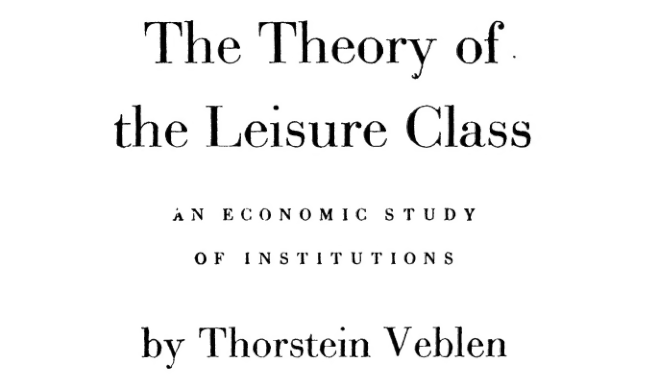
这是凡勃伦《有闲阶级论》第一章中的一些精彩片段。
文献来源:
Veblen, T. 1899. The theory of the leisure class. New York : Macmillan.
text 1
评判标准(standards)与分析视角(points of view)的转变是循序渐进(gradual only)的,极少(seldom)会彻底颠覆(subversion)或完全摒弃(suppression)一套业已被接受的认知立场(standpoint)。
时至今日,人们仍习惯性(habitually)区分生产性职业(industrial occupations)与非生产性职业(non-industrial occupations);这种现代社会的划分方式(modern distinction),正是野蛮时代区分掠夺劳作(exploit)与苦力劳作(drudgery)演变(transmuted)而来的形态。
在大众普遍认知(popular apprehension)中,战争、政务、公共祭祀(public worship)、公共娱乐活动(public merrymaking)这类事务,和加工制造生存物资(elaborating the material means of life)的劳动有着本质上(intrinsically)的区别。
二者清晰的分界(precise line of demarcation)虽和早期野蛮社会的划分框架(early barbarian scheme)不尽相同,但这种宏观层面的区分标准(the broad distinction)并未被废弃(disuse)。
But the change of standards and points of view is gradual only, and it seldom results in the subversion or entire suppression of a standpoint once accepted. A distinction is still habitually made between industrial and non-industrial occupations; and this modern distinction is a transmuted form of the barbarian distinction between exploit and drudgery. Such employments as warfare, politics, public worship, and public merrymaking, are felt, in the popular apprehension, to differ intrinsically from the labour that has to do with elaborating the material means of life. The precise line of demarcation is not the same as it was in the early barbarian scheme, but the broad distinction has not fallen into disuse.【pp.9-10】
text 2
如今人们心照不宣(tacit)、基于常识(common-sense)形成的划分标准(distinction),实质上(in effect)可以概括为:只有最终目的(ultimate purpose)是利用(utilisation)非人事物的活动( non-human things),才能被视作生产性(industrial)努力(effort)。
人与人之间带有强制性质的支配利用(coercive utilisation of man by man ),并不会被认为具有生产职能( an industrial function);
而一切借助非人外部环境(the non-human environment)改善人类生存条件(enhance human life)的劳动,都统一归为生产活动(industrial activity)。
那些完整继承并改良古典理论传统(classical tradition)的经济学家,普遍将人类 “支配自然的能力(man’s power over nature)” 设定(postulated)为生产产出能力/工业生产力(industrial productivity)的核心特征(characteristic fact)。
这种改造自然的生产能力( industrial power over nature),涵盖人类驯养动物、掌控各类自然基础力量(elemental forces)的本领。通过这套界定方式,人类与野兽生灵(brute creation)之间被划出一道明确界限。
The tacit, common-sense distinction today is, in effect, that any effort is to be accounted industrial only so far as its ultimate purpose is the utilisation of non-human things. The coercive utilisation of man by man is not felt to be an industrial function; but all effort directed to enhance human life by taking advantage of the non-human environment is classed together as industrial activity. By the economists who have best retained and adapted the classical tradition, man’s“power over nature” is currently postulated as the characteristic fact of industrial productivity. This industrial power over nature is taken to include man’s power over the life of the beasts and over all the elemental forces. A line is in this way drawn between mankind and brute creation.【pp.10】
text 3
在这种对无生命之物(inert)和有生命之物(animate)的朴素区分(naïve discrimination)的指引(guidance)之下,原始社会群体(primitive social group)的各类活动倾向于被分为两大类别,用现代措辞来讲就是掠夺(exploit)与生产劳作(industry)。
生产劳作是付出精力(effort)去创造全新事物(create a new thing),制作者依靠加工之手(the fashioning hand ),从被动的(passive)(“原始粗野的”brute)原材料(material)之中,为这一事物赋予全新的用途(a new purpose);
而掠夺,就是把此前由另一个主体(another agent)为其他目标(some other end )所付出的力量(energies),转化为(conversion)服务于其(ps:掠夺者)自身目的( his own end)的资源,只要这种掠夺能给行为主体(agent)带来有用的(useful)结果(outcome)。
我们至今仍会提及 “原始粗野的物质(brute matter)”,其中多少带有野蛮人当初赋予这个词汇的深层意义(profound significance)。
Under the guidance of this naïve discrimination between the inert and the animate, the activities of the primitive social group tend to fall into two classes, which would in modern phrase be called exploit and industry. Industry is effort that goes to create a new thing, with a new purpose given it by the fashioning hand of its maker out of passive (“brute”) material; while exploit, so far as it results in an outcome useful to the agent, is the conversion to his own ends of energies previously directed to some other end by another agent. We still speak of “brute matter” with something of the barbarian’s realisation of a profound significance in the term.【pp.12-13】
text 4
正如已经指出(indicated)的那样,掠夺(exploit)与苦役(drudgery)之间的划分,是各类职业(employments)之间带有尊卑歧视属性的区分(invidious distinction)。
那些可以被归为掠夺类(exploit)的职业是有价值的(worthy)、光荣的(honourable)、高贵的(noble);
另一些不包含掠夺成分的职业,尤其是那些暗含顺从(subservience)或臣服(submission)意味的职业,则是无价值的(unworthy)、有损尊严的(debasing)、卑贱的(ignoble)。
尊严(dignity)、价值(worth)或是荣誉(honour)这一概念,无论用于形容人(persons)还是行为(conduct),在阶层(classes)以及阶层划分(class distinctions)的演化过程(development)中具备头等重要的意义(first-rate consequence),因此有必要阐述它的起源(derivation)与内涵(meaning)。支撑这一概念的心理基础(psychological ground)可以大致概述(indicated in outline)如下。
As has already been indicated, the distinction between exploit and drudgery is an invidious distinction between employments. Those employments which are to be classed as exploit are worthy, hon- ourable, noble; other employments, which do not contain this element of exploit, and especially those which imply subservience or submis- sion, are unworthy, debasing, ignoble. The concept of dignity, worth, or honour, as applied either to persons or conduct, is of first-rate consequence in the development of classes and of class distinctions, and it is therefore necessary to say something of its derivation and meaning. Its psychological ground may be indicated in outline as follows. 【pp.15】
text 5
出于筛选层面的必然(selective necessity),男子是行为主体(agent)。
在他自身的认知(apprehension)当中,他是展开冲动性活动(impulsive activity)的核心 —— 也就是 “目的论式的(teleological)” 活动。
他作为行为主体,在每一次行动之中都追求某个具体(concrete)、客观(objective)、非个人化(impersonal)目标(end)的达成(accomplishment)。
正是由于具备这样的主体属性,他天生喜爱富有成效的劳作(effective work),厌恶徒劳无功的付出(futile effort)。
他能够感知有用性(serviceability)或效率(efficiency)所具备的价值(merit),也能察觉无用(futility)、浪费(waste)或是无能(incapacity)所带来的缺陷(demerit)。
这种先天倾向(aptitude)或固有习性(propensity)可以被称作技艺本能(instinct of workmanship)。
只要生活环境(circumstances)或是生活传统(traditions)使人习惯性(habitual)地在效率(efficiency)层面将人与人相互对比(comparison),技艺本能(the instinct of workmanship)就会演变为带有竞争意味或是尊卑歧视性的人际攀比(an emulative or invidious comparison of persons)。
这一结果的显现程度,在很大程度上取决于族群的性格气质(temperament of the population)。
在任何一个习惯于开展这种歧视性人际对比( invidious comparison of persons)的社群(community)里,外在可见的成功(visible success )本身就会成为追求目标,因为它能作为获取他人尊重(esteem)的依据。
人们通过展现自身的办事效率来收获尊重(Esteem)、规避非议(dispraise)。
最终,技艺本能(the instinct of workmanship)会转化为带有竞争性质的实力展示( an emulative demonstration of force)。
As a matter of selective necessity, man is an agent. He is, in his own apprehension, a centre of unfolding impulsive activity—“teleological” activity. He is an agent seeking in every act the accomplishment of some concrete, objective, impersonal end. By force of his being such an agent he is possessed of a taste for effective work, and a distaste for futile effort. He has a sense of the merit of serviceability or efficiency and of the demerit of futility, waste, or incapacity. This aptitude or propensity may be called the instinct of workmanship. Wherever the circumstances or traditions of life lead to an habitual comparison of one person with another in point of efficiency, the instinct of workmanship works out in an emulative or invidious comparison of persons. The extent to which this result follows depends in some considerable degree on the temperament of the population. In any community where such an invidious comparison of persons is habitually made, visible success becomes an end sought for its own utility as a basis of esteem. Esteem is gained and dispraise is avoided by putting one’s efficiency in evidence. The result is that the instinct of workmanship works out in an emulative demonstration of force.【pp.15-16】
text 6
因此,平和(peaceable)文化阶段与掠夺性(predatory)文化阶段之间实质性的区别(substantial difference),是精神层面(spiritual)的区别,而非物质工具层面(mechanical)的区别。
精神心态(spiritual attitude)的转变,是群体生活物质现实(material facts)发生改变所衍生的结果(outgrowth);当有利于掠夺心态(favourable to a predatory attitude )形成的物质环境(material circumstances)逐步出现(supervene)时,这种精神转变便会缓慢发生。
掠夺文化(the predatory culture)的下限(inferior limit)是生产限度(an industrial limit)。
只有当生产方式(industrial methods)的效率(efficiency)发展到一定水平,在维持谋生者基本生存(subsistence)之外,还能留出值得争夺的剩余物资(margin worth fighting for),掠夺才能成为任何群体或阶层习惯性(habitual)、常规性(conventional)的手段(resource)。
所以,从平和阶段向掠夺阶段的过渡(transition),依托于技术知识(technical knowledge)的发展与工具的使用(the use of tools)。
在远古时期,掠夺型文明无法形成,除非武器(weapons)发展到足以让人类具备强大威慑力(formidable)的程度。
当然,工具与武器的早期发展,只是同一客观事实从两种不同视角(points of view)观察得出的两种表述。
The substantial difference between the peaceable and the predatory phase of culture, therefore, is a spiritual difference, not a mechanical one. The change in spiritual attitude is the outgrowth of a change in the material facts of the life of the group, and it comes on gradually as the material circumstances favourable to a predatory attitude supervene. The inferior limit of the predatory culture is an industrial limit. Predation cannot become the habitual, conventional resource of any group or any class until industrial methods have been developed to such a degree of efficiency as to leave a margin worth fighting for, above the subsistence of those engaged in getting a living. The transition from peace to predation therefore depends on the growth of technical knowledge and the use of tools. A predatory culture is similarly impracticable in early times, until weapons have been developed to such a point as to make man a formidable animal. The early development of tools and of weapons is of course the same fact seen from two different points of view.【pp.20】
text 7
只要习惯性的争斗(habitual recourse to combat)没有使争斗成为人们日常思想的焦点(foreground in men’s everyday thoughts),成为人类生活的主导特征(dominant feature),那么一个群体的生活就可以被描述为和平的。
显然,一个群体可能在不同程度上达到这种掠夺性的态度,以至于其生活方式(scheme of life)和行为准则(canons of conduct )在不同程度上受到掠夺本能(predatory animus)的控制。
因此,文化的掠夺阶段(The predatory phase of culture)被认为是逐渐形成的,是通过掠夺能力(predatory aptitudes)、习惯(habits)和传统(traditions)的累积增长(cumulative growth )而实现的。
这种增长源于群体生活环境(circumstances)的变化,这种变化发展(develop)并保留(conserve)了那些使人走向掠夺而非和平生活的人性特征( traits of human nature )以及传统和行为规范(traditions and norms of conduct)。
The life of a given group would be characterised as peaceable so long as habitual recourse to combat has not brought the fight into the foreground in men’s everyday thoughts, as a dominant feature of the life of man. A group may evidently attain such a predatory attitude with a greater or less degree of completeness, so that its scheme of life and canons of conduct may be controlled to a greater or less extent by the predatory animus. The predatory phase of culture is therefore conceived to come on gradually, through a cumulative growth of predatory aptitudes, habits, and traditions, this growth being due to a change in the circumstances of the group’s life, of such a kind as to develop and conserve those traits of human nature and those traditions and norms of conduct that make for a predatory rather than a peaceable life.【pp.20-21】