
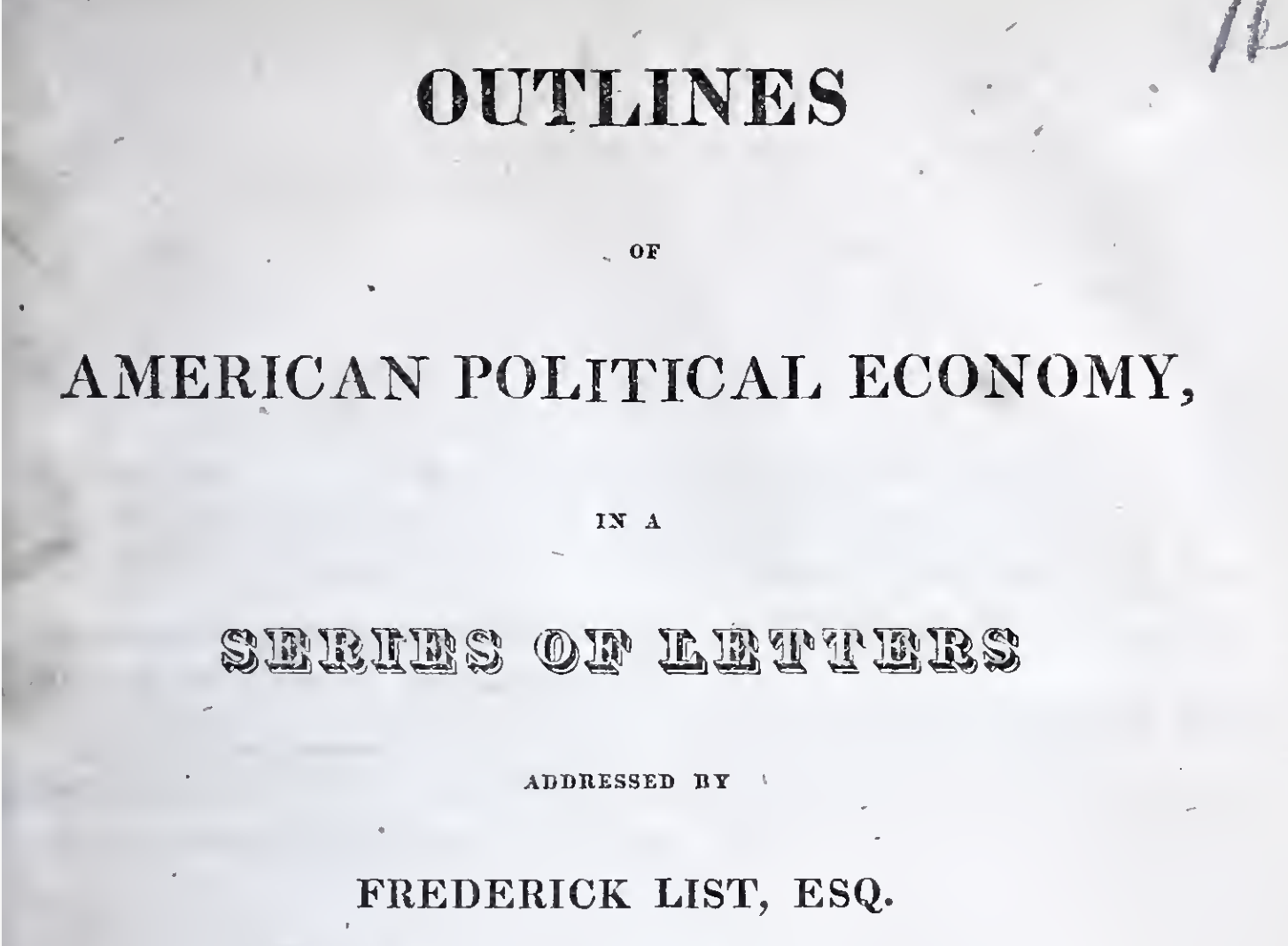
这是李斯特在1827年的《美国政治经济学纲要》(Outlines of American Political Economy)中的一些精彩论述。全书共40页,涵盖13篇letters。
文献来源:List, Friedrich. 1827. Outlines of American political economy. Philadelphia: Samuel Parker.
text 1
这些理论家将世界主义原则(cosmopolitical principles)与政治原则(political principles)混淆,因此完全误解了政治经济学的目的( the object of political economy)。
政治经济学的目的并非像个人主义和世界主义经济学( individual and cosmopolitical economy),特别是商人的贸易(the trade of a merchant)那样,通过物质交换(exchanging matter for matter)来获取物质(gain matter),而是通过与其他国家交换(exchange with other nations)来获取生产力和政治力量(gain productive and political power),或者通过限制这种交换(restricting that exchange)来防止生产力和政治力量的衰退(prevent the depression of productive and political power)。
因此,他们主要讨论的是物质交换( the exchange of matter )的影响,而不是生产力(productive power)本身。
由于他们没有将生产力(productive power)及其在一个国家兴衰的原因(the causes of its rise and fall)作为研究的主要对象(principal object),他们既没有认识到生产力各个组成部分( the different component parts)的真正作用,也没有认识到物质交换(the exchange of matter)和物质消耗(consumption)的真正作用。
他们将人类工业(human industry)生产的现有物质存量(the existing stock of matter)统称为资本(capital),并赋予(ascribed)这一存量的各个组成部分(the different component parts)一种共同的(common)、平等的(equal),甚至是无所不能(omnipotent)的作用(effect)。
他们认为,一个民族的工业(industry)取决于其资本(the amount of capital)或生产资料的存量(stock of produced matter);他们没有考虑到,这类资本的生产力(the productiveness of this capital),既取决于自然赋予的资源禀赋(the means afforded by nature),也取决于一个国家的智识发展水平与社会整体状况(the intellectual and social conditions of a nation)。
下文将阐明,如果科学需要用“资本”(capital)这一通用术语来指代现有的生产资料存量(the existing stock of produced matter),那么同样有必要为现有的自然资源存量(the existing stock of natural means)以及现有的社会和智力状况(the existing state of social and intellectual conditions)创造一个通用术语:换言之,存在着自然资本(a capital of nature)、智力资本(a capital of mind)和生产物质资本(and a capital of productive matter),一个民族的生产力(the productive powers)不仅取决于后者,而且主要(principally)取决于前两者。
As these theorists confounded cosmopolitical principles with political principles, so they entirely misapprehended the object of political economy. This object is not to gain matter in exchanging matter for matter as it is in individual and cosmopolitical economy, and particularly in the trade of a merchant. But it is to gain productive and political power by means of exchange with other nations, or to prevent the depression of productive and political power, by restricting that exchange. They treat, therefore, principally of the effects of the exchange of matter instead of treating of productive power. And as they made not the productive power, and the causes of its rise and fall in a nation, the principal object of their inquiry, they neither appreciated the true effect of the different component parts of productive power, nor the true effect of the exchange of matter, nor of the consumption of it. They called the existing stock of matter produced by human industry by the general name of capital, and ascribed to the different component parts of this stock not only a common and equal, but an omnipotent effect. The industry of a people is, according to them, restricted to the amount of capital, or stock of produced matter; they did not consider that the productiveness of this capital depends upon the means afforded by nature, and upon the intellectual and social conditions of a nation. It will be shown hereafter that if the science requires for the existing stock of produced matter the general term of capital, it is equally necessary to create for the existing stock of natural means, as well as for the existing state of social and intellectual conditions, a general term: in other words, there are a capital of nature, a capital of mind, and a capital of productive matter, and the productive powers of a nation depend not only upon the latter, but also and principally upon the two former. (List,1827:18-19)
text 2
认为一个国家的生产力(the productive power of a nation)受限于其物质资本(capital of matter)的说法是不成立的。
萨伊和斯密只关注物质之间的交换(the exchange of matter for matter),即获取物质(gain matter),他们赋予了物质一种它并不具备的全能性(an omnipotent effect)。
生产力的绝大部分在于个人的智力和社会条件(the intellectual and social conditions of the individuals),我称之为精神资本(capital of mind)。
假设全国有十位单干的毛织工,每人拥有一千美元的资本;他们用纺车纺纱,工具简陋,不擅长染色,每个人都是自己生产,事事亲力亲为,因此每人每年只能生产价值不超过一千美元的布匹。现在假设这十位织工联合起来,共同研发纺纱机和更先进的织布机,学习染色技术,分工合作,这样他们每月就能生产并销售价值一万美元的粗呢布。同样价值1万美元的物质资本,过去每年只能生产价值1万美元的粗布;如今,由于社会和知识条件的改善(the improved social and intellectual conditions),或者说由于精神资本的积累(the acquired capital of mind),可以生产价值10万美元的粗布。
同样,一个国家如果拥有同样的物质资本(the same existing matter),只要改善社会和知识条件( social and intellectual conditions),其生产力(productive power)就能提高十倍。
It is not true that the productive power of a nation is restricted by its capital of matter. Say and Smith having only in view the exchange of matter for matter, to gain matter, ascribe to the matter an omnipotent effect which it has not. Greater part of the productive power consists in the intellectual and social conditions of the individuals, which I call capital of mind. Suppose ten single woollen weavers in the country possess a thousand dollars capital each; they spin the wool by the wheel, they possess very inferior tools, they are not skilled in the art of dyeing, each of them manufacturing for himself, must do everything himself, and therefore each produces not more than one thousand dollars of cloth a year. Suppose now the ten manufacturers unite their capital and their labour, they invent a spinning machine, a more perfect weaving machine, they are instructed in the art of dyeing, they divide the labour amongst them, and in this way they are enabled to manufacture and to sell every month ten thousand dollars’ worth of broad cloth. The same capital of matter amounting to $10,000 produced formerly only $10,000 worth of broad cloth a year, produces now by the improved social and intellectual conditions, or by the acquired capital of mind, $100,000 worth of broad cloth. So can a nation with the same existing matter improve its productive power tenfold in improving its social and intellectual conditions.(List,1827:20-21)
text 3
第三,问题的关键是:美国究竟是否能够:
(1)通过发展棉纺织和毛纺织业等自然手段来提高生产力?(自然资本)。
By its natural means to increase its productive power, by fostering cotton and woollen manufactories? (capital of nature).
(2)凭借其现有的勤劳、教育、进取精神、毅力、军队、海军力量、政府(精神资本),可以合理地预期它能够获得必要的技能,在短时间内通过这些工厂完成其生产力,并且如果获得了政治权力,它能否保护这些工厂。
Whether by its present industry, instruction, enterprising spirit, perseverance, armies, naval power, government (capital of mind), it is reasonably to be expected that it can acquire the necessary skill to complete in a short time its productive power by these manufactories, and whether it can protect them by political power if acquired.
(3)是否存在如此之多的食物、器皿、材料、原材料等(物质资本),以至于能够公平地利用自然资本和精神资本继续发展?
Whether there exists so much superabundance of food, utensils, materials, raw stuff, etc. (capital of matter), as to go on fairly by using the capital of nature and employing the capital of mind.(List,1827:21)
text 4
先生,从这个例子您就能明白,斯密和萨伊关于物质资本增长缓慢(capital of matter increases but slowly)的论断错得多么离谱。
这在过去工业发展受到种种限制、化学、机械等新技术尚未出现的时候或许成立;在那些几乎所有自然资源都已被利用的古老定居国家,这或许也成立;但在一个新兴国家,情况就截然不同了。
在这个国家,自然资本(the capital of nature)的利用率不足十分之一,新的发明(new inventions)创造层出不穷,工业摆脱了一切阻碍,简而言之,一个全新的社会状态(a new state of society)已经形成了前所未有的精神资本(a capital of mind)。
如果这样一个国家的人口以前所未有的速度增长,那么只要社会足够明智(wise),能够运用(employ)其精神资本(capital of mind)去开发和利用(develop and use)其所拥有的自然资本(the capital of nature),物质资本(capital of matter)的增长速度甚至会超过人口的增长速度。
From this example, sir, you may learn how far wrong Smith and Say are in asserting that capital of matter increases but slowly. This was true in former times when industry was checked in every way, when the new powers of chemistry, of mechanics, etc., were not yet in existence: it was true in old settled countries, where nearly all natural means were already used; but it is not true in a new country, where not the tenth part of the capital of nature is in use, where new inventions do wonders, where industry is delivered of all hindrances, where, in short, a new state of society has formed a capital of mind never experienced. If population increases in such a country in a degree never experienced, the increase of capital of matter will outstrip even the increase of population, if the community be wise enough to employ its capital of mind in order to develop and use the capital of nature with which it is blessed.(List,1827:22)
text 5
在国民经济中,各项措施(measures)和事件(events)、个人的条件(condition)和技能(arts)所产生的影响,与不同国家所处的具体环境一样千差万别;总的来说,如果这些措施和事件能够促进(promoting)国家的生产力发展,那么它们就是有益的;反之则不然。
每个国家都必须遵循自身发展生产力的道路(its own course);换言之,每个国家都有其独特的政治经济模式( particular political economy)。
In national economy, the effect of measures and of events, of the condition and of the arts of individuals, is as different as the circumstances are, in which the different nations are existing; and all that in general can be said is this, that if they are promoting the productive power of the nation, they are beneficial; if not—not. Every nation must follow its own course in developing its productive powers; or, in other words, every nation has its particular political economy.(List,1827:24)